Kraków · Backpacking
Checked 31 August 2026 · 7 official sources
ON A BUDGET
Kraków is one of the cheaper big cities in the EU, and the single lever on your budget is whether you eat and drink inside the Planty ring or one street outside it.
What a day costs
The fixed costs are small: a 90-minute transit ticket is 9 zł and a 24-hour pass 20 zł under the tariff in force since 2 March 2026, the Dragon's Den under Wawel is 15 zł and the Lem Experimental Garden 21 zł. Add a hostel bed and two meals and most people land between 150 and 250 zł a day — milk bars versus Main Square terraces is the whole difference between those two numbers.
📍 Map & photos · $ · Website ↗
Tram and bus tickets
Zone I covers the whole city. Since 2 March 2026: one trip 6 zł, 30 minutes 6 zł, 60 minutes 8 zł, 90 minutes 9 zł, 24 hours 20 zł, seven days 65 zł, all halved for reduced fares. Buy in an app (mPay, iMKA, moBiLET), at a machine or from the on-board machine, and validate straight away.
📍 Map & photos · $ · Website ↗
Train in from Kraków Airport
Koleje Małopolskie runs from a station joined to the terminal by a covered footbridge to Kraków Główny for 20 zł. Buy from the machine on board, from the conductor (cash or card), or at the airport desk, open 08:10–19:45. The trains have Wi-Fi and power sockets and luggage costs nothing.
📍 Map & photos · $ · Website ↗
Milk bars (bary mleczne)
Subsidised self-service canteens left over from the communist era and still running: you order pierogi, soup or naleśniki at a hatch, carry your own tray and pay a fraction of restaurant prices. No alcohol, cash is often easier, and most shut in the early evening. There is a cluster on and just off Grodzka in the Old Town.
📍 Map & photos · $
What costs nothing
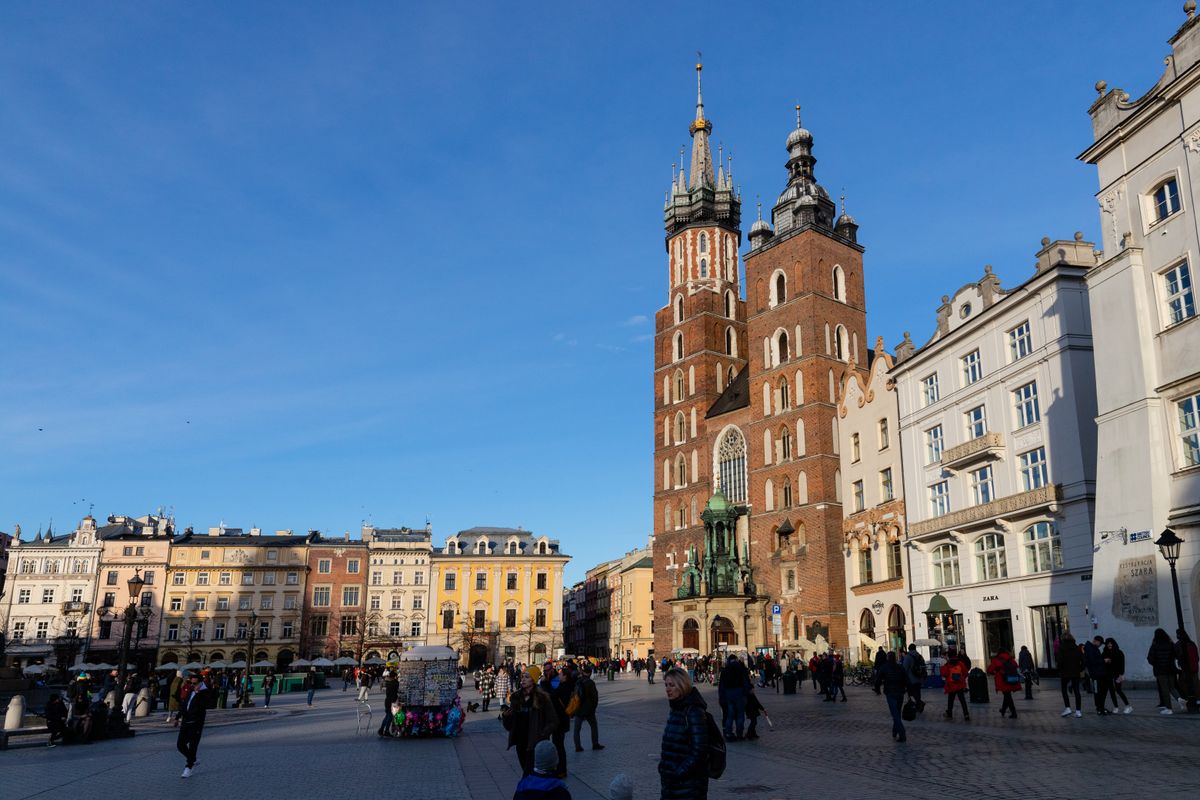
The Planty ring laid out on the line of the demolished city walls, the Main Market Square itself, the 48-hectare Błonia common a 15-minute walk west of the square, and the Vistula boulevards below Wawel. Almost everything you pay for in Kraków is underground or indoors.