Naples
Checked 1 September 2026 · 5 official sources
EUROPE · FIESTA SIDE
Loud, dense and entirely itself. Naples has the best pizza anywhere, a museum holding everything portable from Pompeii, and a live volcano watching the whole arrangement.
The plan
Pompeii
Eighteen years of renewed excavation have opened streets that were closed a decade ago. Open 9am with last entry 5.30pm and closing at 7pm from 16 March to 14 October, and 9am to 5pm with last entry 3.30pm through winter. From January 2026 the site alone is €20, €25 with the suburban villas and €30 for the three-day Pompeii Plus. Entry is capped at 20,000 a day — in high season 15,000 before 1pm and 5,000 after — and tickets are personal, so book in the name of whoever is using them. Free on the first Sunday of the month, which is also the worst day to come.
📍 Map & photos · $$ · Website ↗
National Archaeological Museum
The Farnese Hercules, the Alexander mosaic, and the erotic Gabinetto Segreto. Everything portable that came out of Pompeii and Herculaneum ended up here, which is why you should come before the excavations rather than after.
📍 Map & photos · $$
Cappella Sansevero
Giuseppe Sanmartino's Veiled Christ, carved from a single block with the marble shroud clinging to the body. Open daily 9am to 7pm, closed Tuesdays, last entry half an hour before closing. The rooms are tiny and numbers are capped, so book.
📍 Map & photos · $ · Website ↗
Napoli Sotterranea
Forty metres down: Greek tuff quarries, Roman aqueduct channels and a Second World War air-raid shelter still holding the beds people slept in. Some passages are shoulder-width and candle-lit, which is not the moment to discover you are claustrophobic.
📍 Map & photos · $
Pizza on Via dei Tribunali
Naples invented it and still does it in about ninety seconds at 485 degrees. The famous places on and around Via dei Tribunali run queue systems; the unfamous ones on the same street are usually as good and empty.
📍 Map & photos · $
Getting there
Napoli Centrale
High-speed trains put Rome about an hour and ten minutes away and Milan under five hours. Centrale sits on Piazza Garibaldi, which is scruffy and pickpocketed; keep your bag in front of you crossing it.
Circumvesuviana to the ruins
The EAV local line from Napoli Porta Nolana and Centrale serves Ercolano Scavi and Pompei Scavi. It is slow, crowded, often without working air conditioning and a known spot for phone theft. The tourist-oriented Campania Express covers the same route with reserved seats.
Ferries from Molo Beverello
Hydrofoils and fast boats to Capri, Ischia, Procida and Sorrento leave from Molo Beverello, walkable from Piazza Municipio. Car ferries go from Calata Porta di Massa nearby. Services thin out sharply from November.
When to go
Best time to go
April to June and September to October: warm, and Vesuvius is climbable without heatstroke.
Cheapest months
November to March is cheapest and wettest, though the city itself barely slows down.
Priciest & busiest
July and August, when the heat sits in the streets and the islands and coast are full.
If you've got one day
Morning
The Archaeological Museum first, so the frescoes and mosaics make sense of the empty rooms at Pompeii later.
Late morning
Walk Spaccanapoli, the dead-straight Greek street that splits the old city, stopping at the Cappella Sansevero.
Lunch
Pizza on Via dei Tribunali, then a coffee taken standing at the counter, which is how it costs a euro.
Afternoon
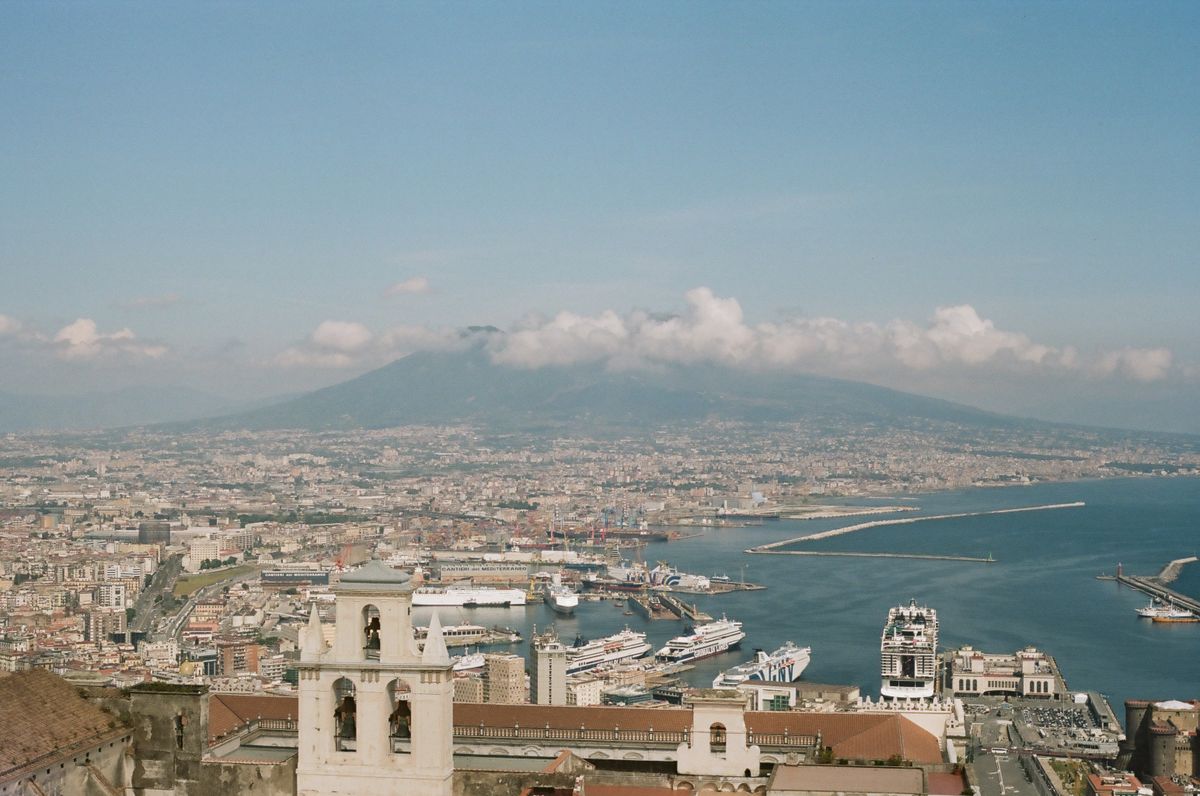
Down into Napoli Sotterranea, or up the funicular to the Certosa di San Martino for the view over the bay.
Evening
Aperitivo in Chiaia, dinner late, then the walk along the Lungomare with Vesuvius blacked out against the sky.
Nearby & day trips
Vesuvius
The crater rim is a bus from Ercolano or Pompeii up to Piazzale Quota 1000, then a gravelly half-hour walk on a ticketed park path. Combining it with the ruins in one day is standard, and long.
Procida
The smallest and least developed island in the bay, forty minutes by ferry, with the painted fishermen's houses at Marina Corricella and none of Capri's prices.
The full episode drops on our socials — follow along: